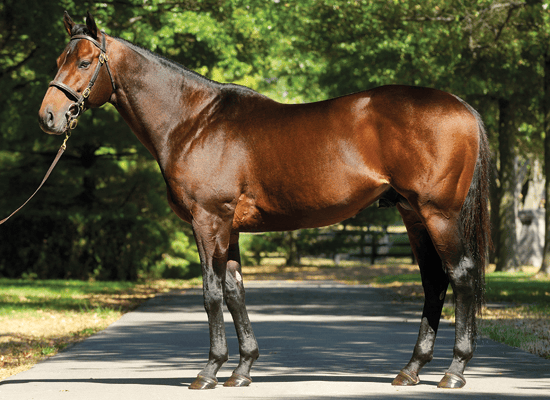
Teao’s sire Ya Primo foaled in 2015. He is sired by Mastercraftsman out of Yo Quisiera, making him part of a distinguished lineage. He gained prominence after winning the Gran Premio Latinoamericano (G1) in 2019. Following his success in South America, he was sent to the United States to race under trainer Chad Brownhttps://www.thoroughbredracing.com/articles/3954/watch-out-america-pride-chile-his-way-join-chad-brown/
Linebred notable ➡️
5×5 Balconajae (ARG) by Pronto #BT – https://www.pedigreequery.com/balconaje, a prolific Chilean stallion breeding successful G1 sires. His pedigree traces back to notable thoroughbred ancestors, inclusive Ksar/Bruleur – Embrujo/Congreve – Rustom Pasha (Son-in-Law), Bois Roussel, Hurry On, Papyrus, the hallmark carriers of toughness and adaptability.
Byerley Turk descendants, its typical case of disappearing recognition.
Argentina, Brazil and Chile had access to the best bloodlines in the world.
6x5x5 Mr Prospector – his genetic footprint is ubiquitous in modern thoroughbred racing, and cornerstone of elite pedigrees. The Speed and Stamina character – an explosive sprinting ability passed to progeny. https://www.americanclassicpedigrees.com/mr-prospector.html
Teao’s distaff looks to @Genetic siring heavy-weights @ Seductor (ARG) & overall thru 3x Rustom Pasha (Family 2-N) (GB) upon 5th dam Tanzania https://www.pedigreequery.com/tanzania5 all, still remain dominant.
The pedigree of colt Teao is the thoughtful reminder that Chile’s bloodlines are to be highly considered.
To this case – Chilean bred distaff is Kitasan Black (JPN) sire of international G1 performer (Timeform rating of 136) Japanese Horse of the Year in 2022 & 2023 Equinox (JPN). Kitasan Black distaff @ Chilean dam Noris + 5×5 Lyphard!! https://www.pedigreequery.com/kitasan+black also Female- Family 9g, a #G Haplotype!
Presumption was not long in changing to disappointment. My recipes for success were of no avail against the persistent successes of my rivals. The truth was that in spite of all I had seen and read I had not yet learned to reflect, – to reflect, that is, on the why and the wherefores.Senor Federico Tesio.
A recent discussion on forums has addressed the leading racing mares and the statistical observation that their immediate progeny may not replicate their comparable success.
To recognize this familiar problem are amongst complexes to the thoroughbred hybrid status.
A Table of representative Haplotype, to genetic variant versatility, tracing out in-built Types further deepens appreciation towards selection & Character.
Most fortunate has Japan’s model and racehorse development. They have scientifically positioned what the racing Thoroughbred requires to be athletic and more continues to knowledge & improvement.
In essence, home-base is the G haplotype where exists the chromosome. The first molecule sighting Chromosome 18 for racehorse genetics. Studies have explored how genetic markers on Equine Chromosome 18 (ECA18) relate to elite performance and optimal race distance, plus (apparently) the early prognosis to 2 year old fractures. Specifically, single nucleotide polymorphisms (SNPs) @ ECA18.
Chromosome 1 – Equine myopalladin refers to the MYPN gene, which encodes myopalladin, a protein involved in muscle structure and function. Myopalladin plays a crucial role in skeletal and cardiac muscle, helping regulate actin organization and maintaining muscle integrity.
In horses, genetic studies have identified MYPN as a potential target of selection in Thoroughbreds, particularly in relation to racing performance. Some research suggests that variations in this gene may influence muscle development.
G Haplotype ‘availability’ is the big clue.
A contemporary pedigree may still ‘figure’ to analyse such carrier strains: cross in/from or ‘link’ through numerous variable hybrid sources a ‘similar dominant potency to co-affinity in-origin Type’, which contributes homozygosity.
There are two main ‘at-origin’ G sources, however Byerley Turk line and Godolphin Arabian were not then tested (2010) for C allele. The Quarter horse from a Janus mare by the Godolphin Arab/barb is the founder of C:C quarter horse.
Above all, ‘contributors’ & #G contribution appear most necessary. Should it not carry G within (‘upgrade’ stallion) then a product is possibly ‘lesser’, muscle twitch fibre. Possibly this is where Ken McLean gave to his impression of dominant zig-zag genes, thru any superior individual.
Steve Roman recently demonstrated average Beyer Speed Figure for Triple Crown race winners has declined over the past 40+ years. Some theories ‘why’ include overbreeding ‘same-line’ Y stallions, diminished genetic variation, and commercial breeding practices.
By general terms: a quick suggestive overview of Australasian pedigrees terms may suggest that the nature #G is going ‘into existential crisis’ through unwittingly its direction to over breeding, an over-refinement ecologically of the Thoroughbred.
Note: @1973 – Radicalisation of behaviour (stakes winners vs. ordinary horses) credit source The Typology of the Racehorse, Varola
In contrast German breeding excels to stamina and soundness, the Allegretta influence says enough.
The G haplotype is the truer or deeper character of 1st type racing thoroughbred and well ‘established’ genetically before the GSB 1791 records. Pedigree breeding has gone through many ‘books’ (Versions) duly ‘wars’ that exiled and eliminated ‘other’ Lines, from ‘private’ Stud books, and as absorbed by the ‘official’ version international GSB. In many ways, GSB is the condensed version of ‘thoroughbred’.
Whilst matters remain unclarified, genetic availability is assured, further to rare variants & yet exposure to those has been limited.
by the very nature of natural inheritance, the practical necessity to carry over, present & re-vigorate the G Haplotype
@TBL
Effectively these carriers must represent by numerous variable availability; they ultimately MUST BE PRESENT as other strains are haplotypes (I), L1, L2, L3, **L4 etc. It is not a matter of alone, in-breeding or line-breeding. These carriers shall serve as dominant potency – co-affinity in-origin Type’, contribute the essential (ROH) run of Homozygosity. Equine homozygosity refers to a horse inheriting two identical copies of a particular gene from both parents. This can influence traits like coat color, muscle composition, and genetic health.
At a ‘cool’ 2025 Australian fee, $385k, the Coolmore stallion Wootton Bassett (GB) is the very fine example both by geno and phenotype (please note by reading our most recent posts, the #’G’ detail shall be evident to this remarkable sire).https://www.breednet.com.au/sire/premium/wootton-bassett
***(update) its only come to my attention that the L4 is also of a K Haplotype. To my spectrum this makes more sense where the origin source goes to, in effect. It will be a Post at a later date.)
Ecclesiastes 1:9 “What has been will be again, what has been done will be done again; there is nothing new under the sun.” A cyclical nature of life where despite advancements and changes, fundamental patterns of existence remain the same.