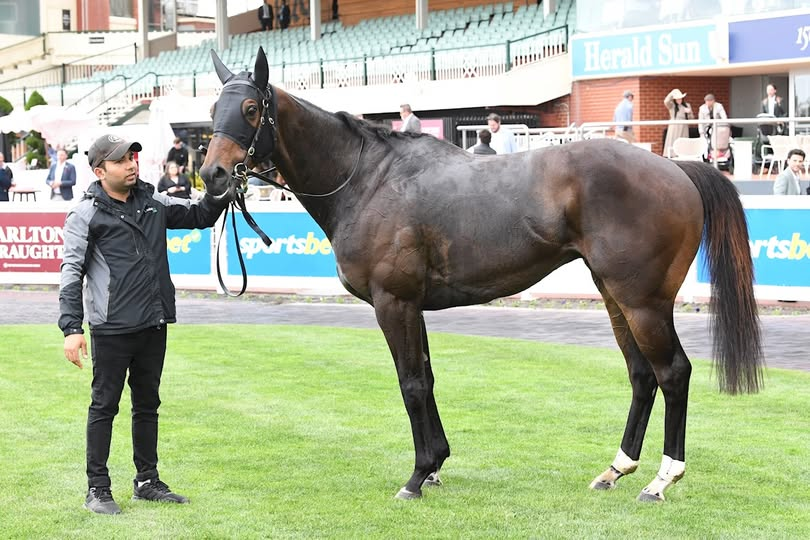
{‘Shocky’ shown here sharing a moment with Flemington strapper Deep after notching up his 14th career win in the Listed Testa Rossa Stakes. The remarkable Here to Shock, Kiwi-bred son of Shocking, is our evergreen 8yo galloper whose reliability, consistency and personality have earned him a large share of real estate in the Lindsay Park team’s heart. It was an excellent ride by Mark Zahra who rated him perfectly in the running before skipping clear on straightening and holding on for a well deserved victory despite carrying the 60kg top weight. Wonderful result for the great Slade Bloodstock ownership group! } Credit ref: FB Linday Park Racing, & Photo 👇
Testa Rossa Stakes I Here To Shock
Here To Shock narrowly sees off Persian Spirit, who was absolutely jumping out of the ground into second ⚡️ A brilliant front-running ride by Mark Zahra.
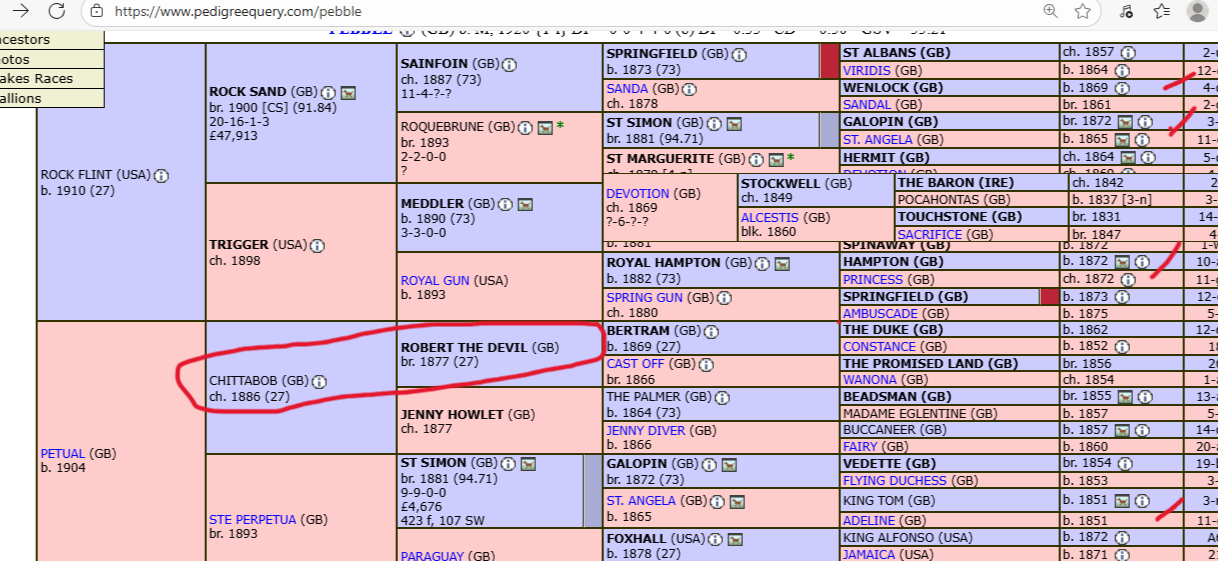
It also mentions little-known English sire Robert the Devil who competed regularly against Bend Or. Not considered successful as a sire, his type-set goes 3x Guiccioli blood which made it to our antipodean shores.
‘Robert’ again surfaces to Sir Dane (NZ) by Summertime (GB) #GA/GB where infused upon Australian family distaff, through his dam Frescoes (Aus), she by Lonhro.
the prototype reflects 3x Guiccioli (f.f. 11) – St Angela f.f. 11 – f.f. 4 Wenlock
Today speed advertising makes its common appeal for breeding progeny successful, competitive, athlete. Conspicuously the decline of stamina influence is surely one powerful background under played. What can be the Geno to reflect it?
Today the market is dominated by commercial breeders who are guided by fashion and stallions need to adapt to the prevailing commercial parameters, currently initial success and speed are everything. Consequently, the bloodlines with more stamina and class are not flashy because they are not shiny and, unfortunately, are not fashionable. Therefore, the demand is low and these paternal lineages are disappearing. CREDIT – https://purosanguedecorrida.blogspot.com/2025/
Of course, the subject of bloodlines is not as simple as favoring one paternal lineage over another. Each stallion represents a mix of influences, and as such, there are opportunities to be taken advantage of. There is an argument that the health of the PSI will not benefit from the current situation, the lack of genetic variety of decades ago already takes its toll in terms of the durability of the breed. And this is an important aspect that must be considered https://purosanguedecorrida.blogspot.com/2025/
Nature of the beast – true classic speed gears with a stamina phenotype, as old day bloodstock writings saw such racehorses as genuine ‘flyers’.
The classic ‘speed ‘ factors were set long, long ago yet modern conjecture implies it appeared or ‘evolved’. By seeking out determining facts rather than premises applied through popularized narrative and other works US researcher, Kathleen Kirsan’s newly released book sets finer parameters. Its clarity has well documented history. It also begins to unravel a modern dilemma just what goes into breeding. Kirsan’s book has an ultimate level of discernment and gathers examined accounts in all matters.
In similar study, we’ve gone re-visiting our old books as this information reveals the curiosities of earlier breeding developments, the why’s of in-breeding and it accounts today where geneticists determine –
Whalebone.
Whalebone heritage records, are thrown as the Father of ‘modern’ racing thoroughbred, stamped to Haplotype TB-dW1, a crown HT-3, born 1807. (Fig 3)
The Historical records development of racing & the Thoroughbred went into a resting period due to the political unrest between 1795 and 1815 (Ireland and Britain were deeply affected by political unrest, rebellion, and war). Breeding and racing trials (testing breeding material) went neglected from 1795 & recommencing 1815. Prior were regular races in different localities (to observe the sire’s progeny performances) having all mixed ages, yearlings to older stock (even at 20 years) went gathered for spectators: the unequalled enthusiasm and sheer fun of the day for amusement and gambling on running horses.
What really weighed out however, would peak at the second half of the nineteenth century that the weight carrying capability of two- and three-year-olds was thought to be much improved; three-year-olds had almost approximately reached that point of weight carrying capability which was formerly held by five- and six-year-olds.
There came however a newly ‘formed’ retrogression of the development where existence of the many short Handicaps for the higher numbers of two-year-old racehorses exceeded the number of three-year-olds making for an obscure turning point that came upon re-producing a lesser resisting power.
Sound familiar?
The ‘mutation’ Tb-dW1, Whalebone (sire, Waxy) has by studbook full brother Whisker (born 1812) Derby winners and full sister Wire born 1811 and at 3 and 4 years a good racer. She had 17 foals ( 15 GSB) and lived to 28 years of age.
Wire is the ancestral dam to stand out sire & racehorse, War Relic (Man O War) – sire of Relic, sire of Pieces of Eight daughter Eight Carat, dam of Octagonal, sire of Lonhro.
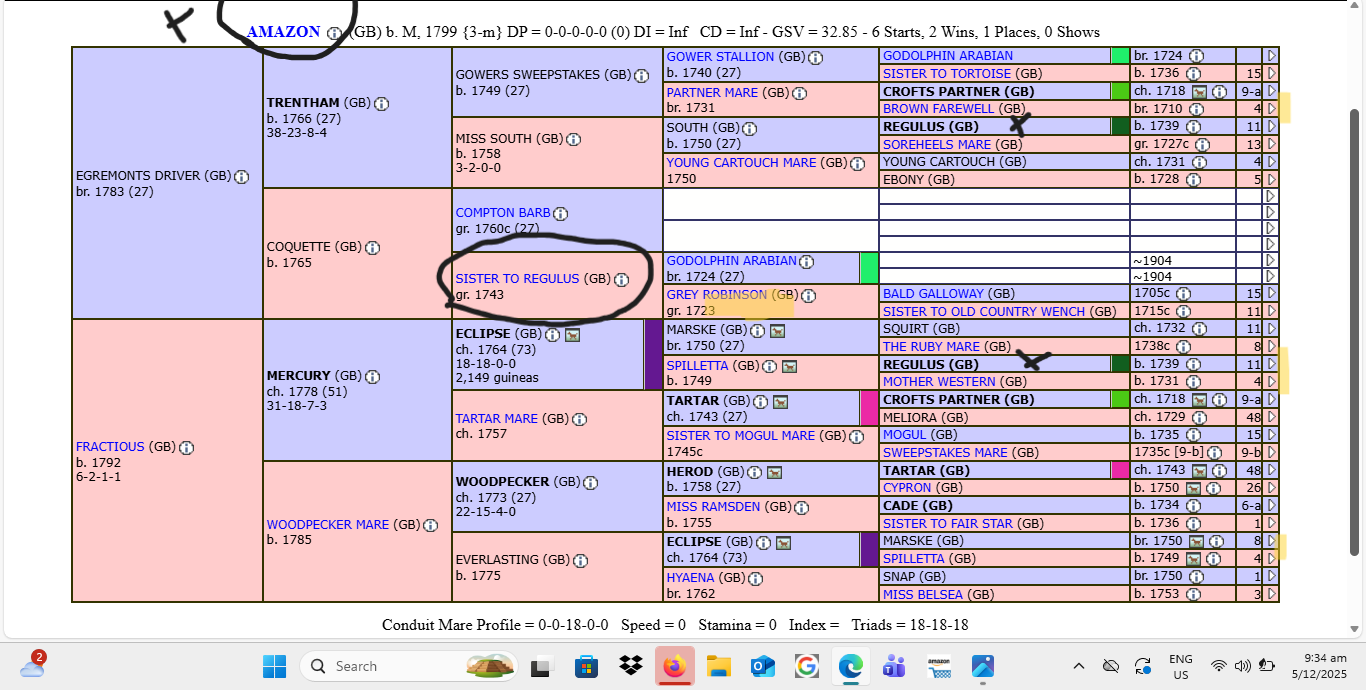
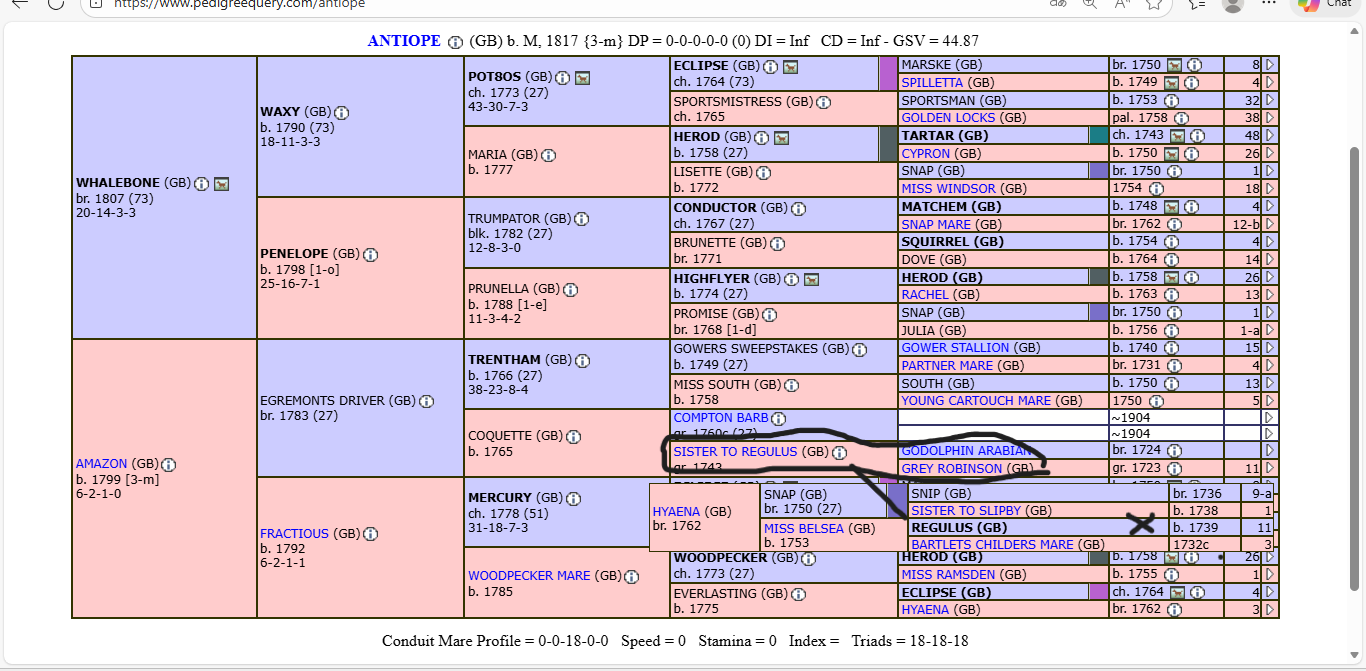
Whalebone, Whisker are the sire factors with female factors @ Family 4 & 11, bred on as f.f. 3-m. What is largely significant to this cross has Sister to Regulus, the Grey Robinson – sedbury mare(s) (these feature to last post)
A modern representative Nashua broodmare sire of Mr Prospector and you will see how that begins to line-up. (Here to Shock – 4×5 Mr P)
The ancestress focus is dam Amazon and her daughter, Antiope (Whalebone) f.f. 3-m akin Isinglass, male line of Swynford (he, 18x Whalebone + 4x Whisker).
Notable sire Star Kingdom, his distaff 4th dam/daughter by Swynford, sire of Biscay (Aus), Here to Shock, 3rd dam distaff.
Such type captures Consols (FR)f.f. 3-m > 3×5 Mieuxce (Fr) observed to sire Shocking’s distaff through Right Boy (IRE) daughter Right Bank.
In the framework of what is a thoroughbred – other european pedigree tables had existed of the later 1800’s – Herman Goos – Frentzel – Antwerp and Lamplighter.
Later Captain Bobinski whom Federico Tesio was a contributor to the compilation of the Bobinski Tables later taken up by Toru Shirai (1989). Breeding Racehorses by the Figure System compiled by Bruce Lowe 1895 supplements the GSB though foundations are revised by geneticists, the GSB still stands.
In consideration of Whalebone’s mutation, full brother and sister, the possible answer is that he, Whalebone, was a half-bred and stated so. The author thought along with a number of others that the necessary in-breeding as required (remember, it was a ‘time’ of setting the blood) proved difficult. As follows…
Half-bred stallions, excellent in their conformation but with insufficient inbreed support as for example Optimus – Whalebone – Sorcerer are often very difficult to mate to get the best results. As in the pedigree of Half-Breds, Thoroughbreds are generally the best ancestors, it is recommendable in Half-bred breeding to direct the inbreeding as far as possible to a Thoroughbred ancestor. B. Von Oettingen Horse Breeding in Theory and Practice. 1907*
To the above, appreciate its true source accounts running horse female families 4 – 11 – 13 and f.f. 3-m through Sister to Regulus, Grey Robinson et al, codex family.