Tags
On the mighty Curragh…the four year old Los Angeles wins the G2 Mooresbridge Stakes.
Los Angeles was a G1 winner at two in France Criterium de Saint-Cloud (2000m) and at three years old – the Irish Derby.
https://www.pedigreequery.com/los+angeles21
3×3 Kingmambo (Mr Prospector) – 4×3 Danehill (Danzig/Northern Dancer et al)
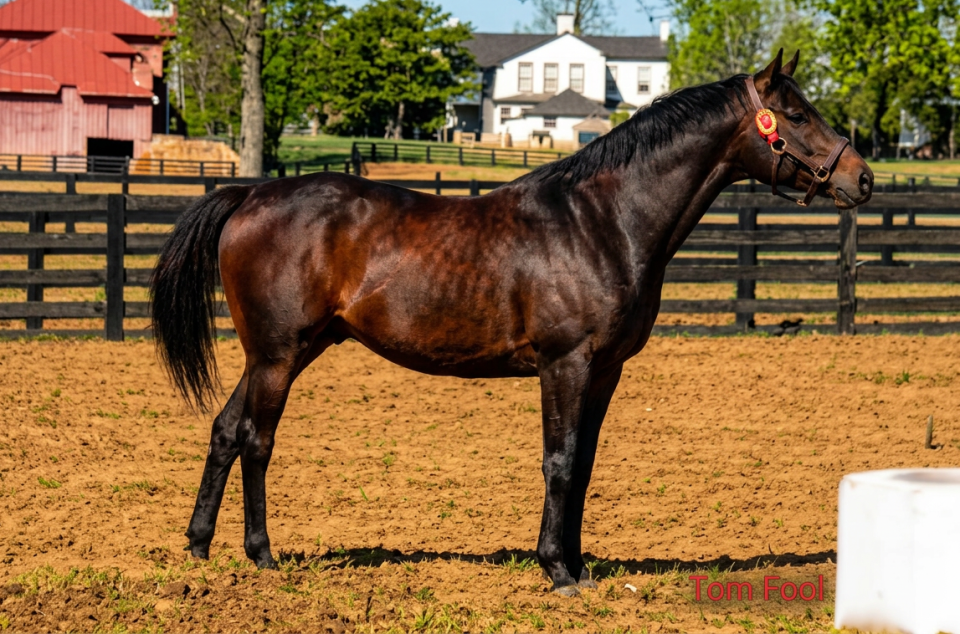
A first impression of this Camelot colt is the rangy type fit for the Curragh and he has a ‘kick’.
https://coolmore.com/farms/ireland/stallions/camelot
@ nuts n’ bolts sire Camelot has his 3rd dam Fade influences in Cyllene blood 15x. Further, Camelot’s distaff @ Favourite below (note has additional key marker to Captivation from same familial dams as William the Third + Beppo)

Recent posts, re-directing pedigrees upon G Haplotype nucleus, duly the inclination to speed muscle fibre and race distance aptitude. Albeit science is comprehensive, the classic speed ‘turn-of-foot’ is firstly an undying stamina to stay, alongside elasticity stride/ flexibility/adaptability.
About ‘past’ & foundational breeds & the How of ‘Type’ and ‘Speed’
Of Equus caballus long ago, hunter-gatherer History (fundamentally) has wild native horse caught & crossed with domesticated specimen and the crosses over time continued to whatever function & geography hence hybrid and or Type culminating to the English bred, Thoroughbred 1791 studbook. The considered arabian–oriental is an admixture of all and of which are further strain-type ‘branches’ as were type sought or a-hem, stolen Arabian by invasion and migration.
The British thoroughbred speed prototype science places, the Shetland Pony, (galloway & hobby natives) to speed gene muscling (its about the muscle fibre not the size of the horse). There are however other crossed-in breeds also where it lands on the Fulani (Arab/Barb Breed Influence: Fulani horses often crossbred with Barb, Dongola, and Arabian horses, a hardy, agile, and resilient animal. From the Cameroon it is similar to the Basuto – a cross between arab, persian and native thoroughbred first appearing about the middle of the 17th century brought by Dutch and Portuguese to the Cape, then called the Cape horse, which also influences the Australian Waler. It is recorded about the Cape Horse as continually ridden at fast speeds over rock ground up and down hills, fearless, sure-footed and with amazing stamina.
{identified two populations with relatively high frequencies of C-alleles (Fulani, 0.33; Shetland 1, 0.50)
https://www.academia.edu/13021482/The_genetic_origin_and_history_of_speed_in_the_Thoroughbred_racehorse
– neither the Byerley Turk nor the Godolphin Arabian sire lines were sampled in the historic data, we cannot preclude them as a source for the C-allele

Tesio saw not at pedigree but the ‘sum of these parts’. Whilst it is considered the modern racing thoroughbred is now fixed-type set, any phenotype comparisons can draw different conclusions as does the full genotype brother or sister.
Thoroughbred Breeding yields for Elite Phenotype: racing & type based on performances across age and race aptitude, distances ranging from 1000m to 3200m. Ken McLean in accounts of earliest and finest American breeders sighted ‘There is never quality speed without the stamina (long) built behind it purposely.’
Perhaps this is exactly why Camelot succeeds as a top genotype sire. His build appeals tough.
@ Pedigree
Camelot, as profiled >Favourite pedigree, a key marker to Captivation from same familial dams as William the Third + Beppo also profiles to Kingmambo’s dam Miesque, her 4th dam by Count Fleet by Reigh Count carries notably same familial line – Contessina/Pitti + Stefan the Great.


Further G haplotype Cyllene sire of Minoru (Princequillo) – Ribot >> @Cyllene reveals 7 X’s (Cicero, Seraphine, Cylgad, Polymelus, Cyclamen, Maid of the Mist) with Hermit 16x

As described to hybrid in-breeding the groundfloor G Haplotype cross affinity to foundations L Haplotype (L1, L2, L3, L4). However (should readers have latched upon posts-past, we’ve introduced fam. 2N as G. Where family 2-e by haplotype classifies is indeterminable, however A haplotype has been suggested elsewhere. (probably Andalusian as the Haplotype also may place to L2 foundational) @Fig 6****below


🐎 Los Angeles (IRE) a Allegretta dam family distaff (ie Galileo/Sea the Star) fam.9-h as a G2 Haplotype. Allegretta also carries Prince Chevalier, another G haplotype (fam. 9f).
Los Angeles dam to 3rd dam sire Riverman has 5 x Teddy. The 12 x Martha Lynn + 3x Spearmint/4x Carbine + 3x Pitti has a mix of G & L4 haplotype. To be clear this is not at all conclusive yet certainly and once again, ‘Pattern’ compelling. There must be a reasonable affinity between the types to be crossed. To note, the 4×3 Danehill is of a L4 Haplotype.
Whilst theoretical considerations made at lines in-breeding or how Haplotype might cross, the final ‘word’ is to back up judgement/assessment to practice what phenotype presents strengths & weaknesses considered.
Camelot & son Los Angeles phenotype? Lipizzaner, Andalusian, anglo-thoroughbred, barb ?? but certainly, strains helpful to the family 9-h plus alike grand-son of the great Montjeu.
In conclusion and again to credit 🙏Ken McLean, who wrote/spoke before these times @Science & Haplotype: “there are a number of “phrases” involved in the evolution of equine speed………………..(he considered) fast fibre muscle naturally evolved from a mixture of specific strains”.
Research info –
*https://www.academia.edu/figures/43408067/table-1-aus-australia-gb-great-britain-ire-ireland-mstn
****Fig6https://pmc.ncbi.nlm.nih.gov/articles/PMC7029099/figure/ece35989-fig-0006/
https://en.wikipedia.org/wiki/Vyatka_horse
Books:
The Horse – the complete book of Horse and Horsemanship (edited by Candida Geddes)
Horses of the World – Daphne Machin Goodall
 The Thoroughbred Link